The claim that 30–40 million Turks live in Iran is nothing more than cheap Azeri-Turkish propaganda. There are about 11 million Azerbaijani-speaking people living in Iran. However, a large part of this population, about 7 million, consider themselves Iranians and say that they aren’t Turks.
The second largest part of Azeri speakers are ethnically Talysh, Kurds, Gilaks, and Mazanis. Although they speak Azeri, they consider themselves neither Azeri nor Turks.
For example, look at the pages on Facebook and X that claim that 30–40 million Turks live in Iran and promote the establishment of a Turkish state in Iran. Most of those who like these ideas and write comments are from Turkey and Azerbaijan. The question arises: if there are 30–40 million Turks in Iran, why do the Turks who supposedly live in Iran not like these ideas? The answer is very simple: there are no more than 500,000 people in Iran who call themselves Turks. The real power in the north of Iran is the Kurds. Even the Gilaks, Talysh, and Mazandarans outnumber the Turks.
So how did it happen that being an Azeri was promoted as being Turkish? Also, why do some Kurds, Talysh, and Gilaks speak Azeri?
This was propaganda prepared by the Soviet Union in the north of Iran from the 1930s to the 1970s. For 40 years, the Soviet Union promoted all cultural elements belonging to the ancient Iranian people, the Azeri, as “Turks.” Within Iran, it published millions of propaganda books on this subject, organized radio broadcasts, and allocated serious money for armed and political movements.
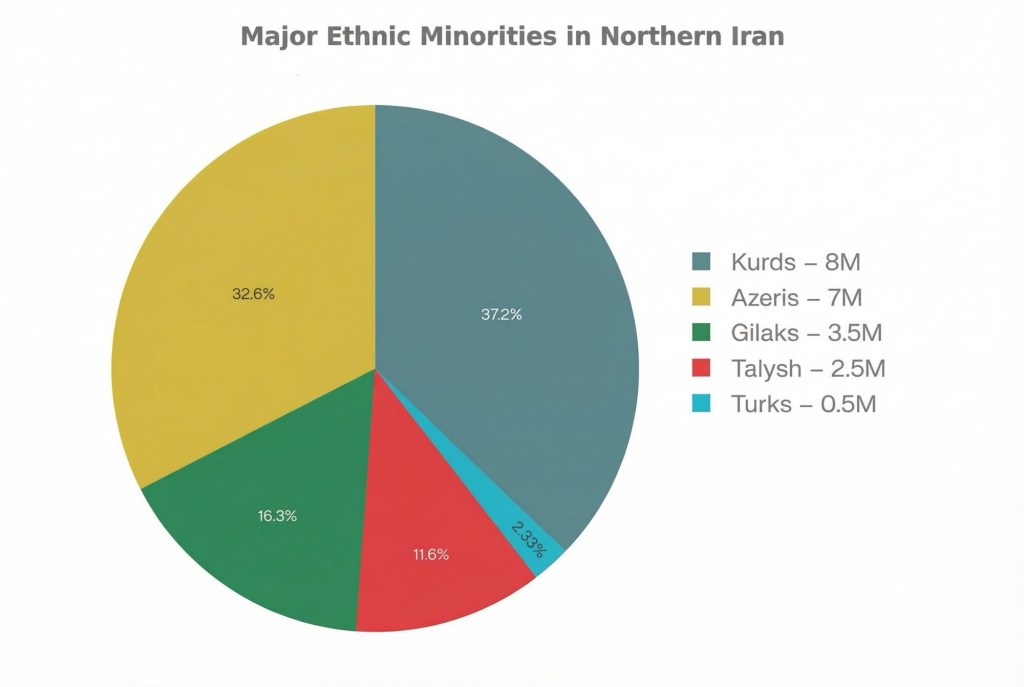
Moscow’s goal was to destroy Iranianism and replace it with an easily manageable Turkism. This propaganda later attracted the interest of Turkey and, in the 1990s, of Azerbaijan, which had gained independence. More precisely, official Baku continued the idea inherited from the Soviet era. Both countries financed this propaganda, but Azerbaijan paid more attention to this issue. Azerbaijan had three main goals here:
1) To direct the Turkish nationalism created by Moscow during the Soviet era inside Azerbaijan against Iran. Thus, Turkish nationalists turned a blind eye to corruption and lawlessness in Azerbaijan because the Aliyev government promised them “new lands.” In this way, a social contract was formed between Aliyev and Turkish nationalists: the Turks don’t touch Aliyev, and Aliyev finances their territorial claims against neighboring countries.
2) To neutralize the Talysh, who number more than 3 million people within the country, by linking them with Iran. The Talysh are actually one of the two strongest ideological centers in Azerbaijan. Although Turkism was artificially created, the national roots of Talyshism are very deep. In reality, the Talysh didn’t support the religious government in Iran, but Aliyev’s media fabricated a story portraying them as ‘pro-Iranian and pro-Russian’ in order to neutralize them and turn Turks against them through propaganda.
3) To attract the interest of the US and Israel, which are against Iran. Azerbaijan knew that the US and Israel wanted to change the regime in Iran and therefore presented the idea of a “Turkish state in Iran” to them as a new weapon, hoping to gain support for itself.
Over time, as a result of the weakness of the Iranian government, the idea of creating a second Azerbaijani state in Iran became more serious and became genuinely popular in Azerbaijan and Turkey, and the idea that 30–45 million Turks supposedly live in Iran gained legitimacy. This idea was no longer a distraction but a propaganda project with a lot of money behind it. Both Azerbaijan and Turkey were already seriously considering the idea of creating a new Turkist state in Iran.
But in reality, without military and weapons support from other countries, the idea of a Turkish state in Iran is nothing more than a fantastic dream.
Rahim Shaliyev
 Avesta Talysh